
School leaders considering a curriculum change are often told that the Finland education model produces better outcomes. But what does the evidence actually say? And how does it compare to the traditional classroom model and methodology many early years schools still use?
This article sets out an evidence-based comparison of the Finland approach against traditional schooling across the dimensions that matter most to school principals and operators: learning outcomes, child wellbeing, staff performance, and long-term school success.
| Related: Ready to act on this evidence? See adopting the Finland curriculum in your school: a guide for principals |
What we mean by traditional schooling
For the purposes of this comparison, traditional schooling refers to the model that still dominates most preschool and early years settings globally: a structured, teacher-led approach in which learning is organised by subject, delivered through direct instruction, and assessed against age-based milestones using standardised measures.
This model is not without merit. It provides structure, predictability, and measurable benchmarks. It is familiar to parents and straightforward to manage. But a growing body of research suggests it is not optimally aligned with how young children actually learn. Iin early years education in particular, the gap between traditional practice and best evidence has become increasingly hard to ignore.
The evidence: six dimensions compared
| Dimension | Traditional schooling | Finland model | What the evidence shows |
|---|---|---|---|
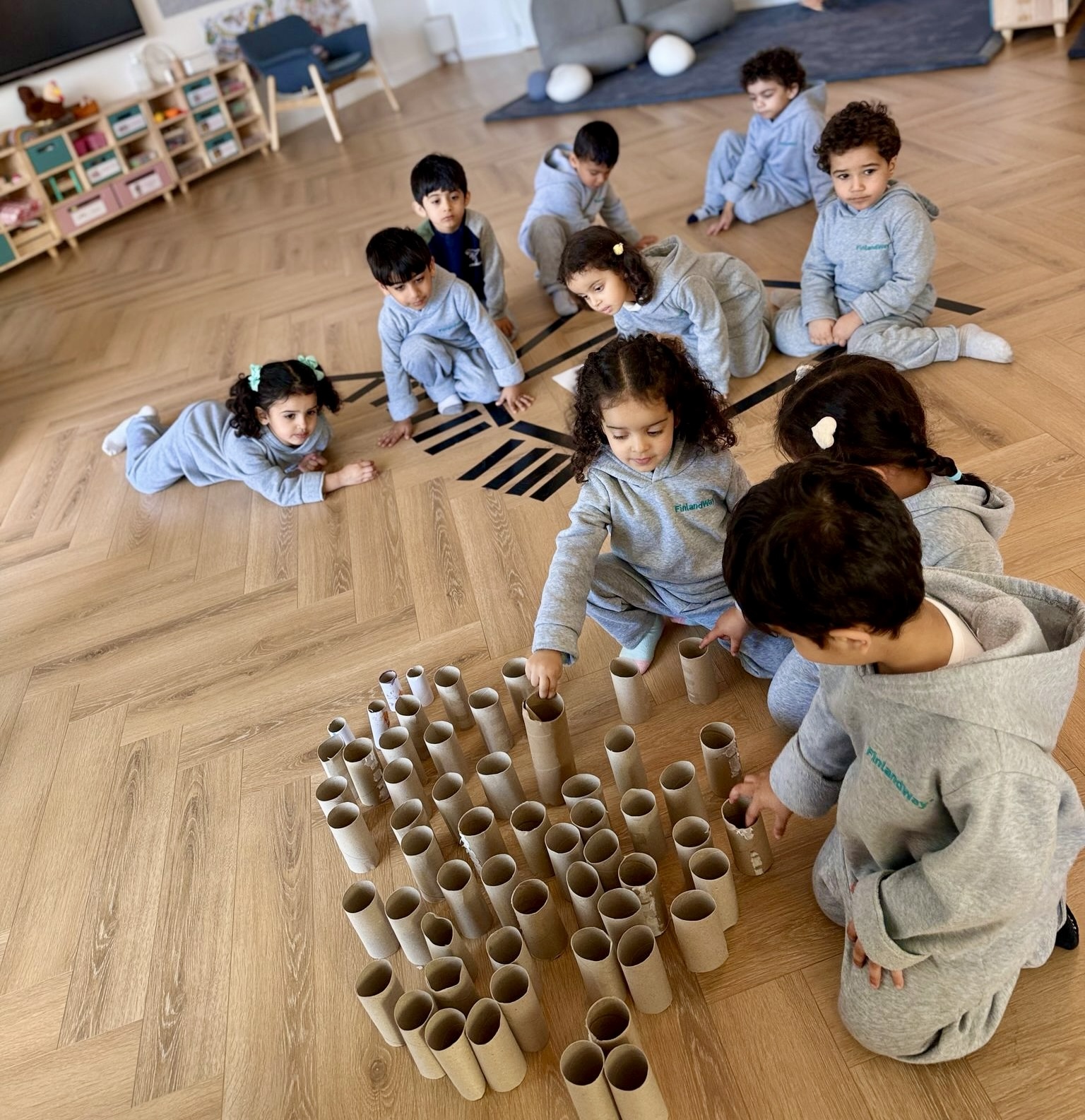
| Cognitive development | Structured content delivery; early focus on literacy and numeracy through direct instruction | Play-based, enquiry-led learning; cognitive skills developed through exploration and problem-solving | Children in play-based early years programmes demonstrate equivalent or stronger cognitive development by age 7, with significant advantages in problem-solving and creative thinking (OECD, 2020) |
| Social & emotional development | Social skills developed incidentally; emotional regulation not explicitly addressed in most curricula | Social and emotional development treated as a core learning domain and explicitly woven into daily practice | Early years programmes with explicit social-emotional learning components show significantly stronger outcomes in emotional regulation, empathy, and collaborative behaviour (Harvard Centre on the Developing Child) |
| Intrinsic motivation | Compliance-based learning; motivation often driven by grades, praise, or avoidance of correction or even punishment | Child-led enquiry builds intrinsic curiosity; children learn because they are engaged, not because they are required to | Research consistently links early play-based learning to stronger intrinsic motivation in primary and secondary school, with lasting effects on engagement and persistence |
| Transition to primary school | Children trained in academic routines may perform well initially but can plateau. Anxiety about performance is common | Play-based learners typically transition with stronger self-regulation, social skills, and learning dispositions | Multiple longitudinal studies, including the HighScope Perry Preschool Project, show play-based early learners outperform traditionally schooled peers in academic, social, and economic outcomes over time |
| Teacher retention & satisfaction | High workload, limited professional autonomy, and low pedagogical satisfaction contribute to staff turnover | Teachers operate within a coherent, evidence-based framework with greater professional autonomy and clear developmental purpose | Schools implementing the Finland model report measurably higher staff satisfaction and significantly lower turnover rates than comparable traditionally structured schools |
| Parent satisfaction & retention | Parents value structure and visible academic output. Satisfaction can be high initially but declines if outcomes plateau | Parents who understand the model become strong advocates. Retention and referral rates are significantly higher | FinlandWay® school partners consistently report higher parent retention rates after full curriculum implementation, with referrals as the primary driver of new enrolment |
The honest case for the traditional model
A comparison like this risks being one-sided if it does not acknowledge what the traditional model does well. For school leaders, an honest assessment is more useful than an advocacy piece.
The traditional classroom model offers:
- Familiarity and parent confidence: many parents — particularly in markets where academic pressure is high — associate structured, teacher-led learning with rigour and quality. Managing this perception is one of the real challenges of adopting a play-based approach
- Predictability: a structured curriculum is easier to plan, monitor, and report on. Observation-based assessment requires more skilled teachers and more sophisticated documentation systems
- Lower training investment: traditional teaching approaches require less specialised professional development, which reduces upfront costs
- Regulatory compatibility: in some markets, early years regulatory frameworks are built around traditional academic milestones. Adopting a play-based approach may require active curriculum development work and engagement with regulators to ensure compliance
These are real considerations that every school leader should acknowledge. The school leaders who make the transition most successfully are those who take these factors seriously and plan for them.
What the evidence does not tell you
The evidence base for the Finland model is strong, but it is important to be clear about what research can and cannot tell you as a school leader:
- Context matters: outcomes from Finnish schools in Finland are not automatically transferable to schools in Saudi Arabia, Morocco, or India. Cultural context, parent expectations, regulatory environments, and staff capability all affect implementation outcomes
- Quality of implementation matters more than the model: a poorly implemented Finland curriculum will produce worse outcomes than a well-implemented traditional one. The quality of training, leadership, and ongoing support is a more significant variable than the curriculum choice itself
- The transition period carries real risk: during the shift from traditional to modern, outcomes can dip before they improve. Schools that transition without adequate preparation and support often conclude that the model does not work when the real issue was implementation quality
This is precisely why the FinlandWay® model places such emphasis on structured implementation, professional development, and ongoing support. The curriculum framework is only as effective as the school’s capacity to deliver it.

What this means for school leaders in practice
For school principals and operators, the evidence points in a clear direction: the Finland model produces stronger outcomes across the dimensions that matter most for child development, staff performance, and long-term school success. However, it is a decision that requires adequate preparation.
The practical implications for school leaders are:
- The evidence justifies the investment in transitioning, but the transition must be properly resourced and led
- Parent communication is a critical implementation variable that determines whether the transition succeeds
- Staff capability and confidence are the primary drivers of outcome quality. Professional development is the investment of time and money that makes the model work
- The choice of implementation partner matters: a curriculum framework without a strong support system is significantly more likely to fail
For the practical transition guide, see how to transition from a traditional classroom to a modern learning model
For the full curriculum adoption process, see adopting the Finland curriculum in your school: a guide for principals
See the evidence in action
Request a curriculum demo from the FinlandWay® schools team. We will show you what the Finland model looks like in practice and how it compares to your current approach.
Frequently asked questions
Is the Finland model suitable for all cultural contexts?
The core principles of the Finland model — play-based learning, holistic development, and child-led enquiry — are grounded in child development research that applies across cultural contexts. However, implementation always requires sensitivity to local parent expectations, regulatory requirements, and cultural norms. FinlandWay® school partners receive support with this contextualisation as part of the onboarding process and through out the application.
What do parents typically find most difficult about the transition from traditional to Finland-model schooling?
The most common concern is academic readiness for primary school. The parents worry that a play-based approach will leave children underprepared for a more formal school environment. The evidence consistently contradicts this concern, but it needs to be addressed proactively and with clear documentation of developmental progress.
Does the Finland model work with mixed-age groups?
Yes. Mixed-age grouping is actually a feature of the Finland early years approach in many contexts, as it supports peer learning, social development, and differentiated teaching. The FinlandWay® implementation team can advise on how to structure learning environments for mixed-age groups.
Are there independent research studies that specifically validate the FinlandWay® model?
The FinlandWay® model is built on the Finnish national ECEC framework, which has an extensive international research base. School-level outcome data from FinlandWay® partner schools is available to serious applicants during the due diligence process.